
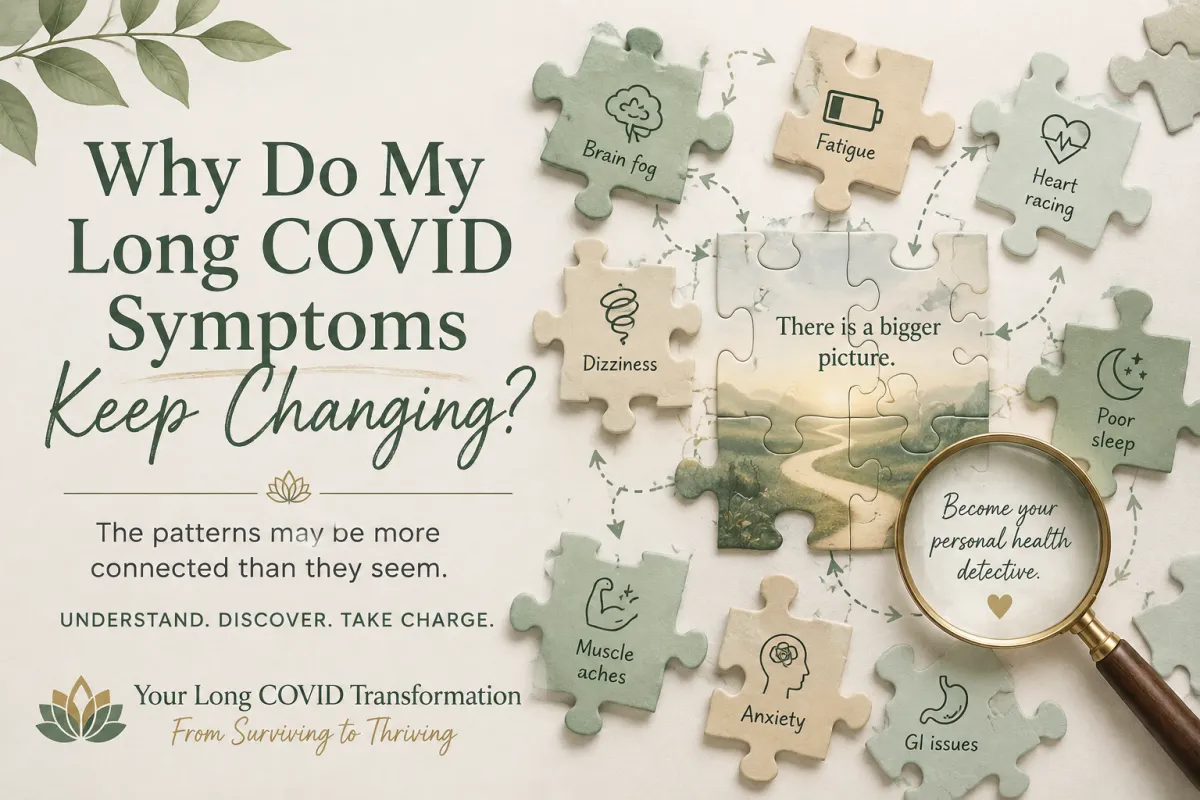
Why Do My Long COVID Symptoms Keep Changing?
Why can’t I figure out what’s going on?
Something I hear a lot is, “Everything is so random! It’s impossible to connect the dots!”
I get it. Symptoms go away and come back. New ones pop up out of nowhere. You feel fine one day, and the next you’re crashing even though you didn’t do anything new. Things you used to be able to do are suddenly too much. Stuff that “shouldn’t” be hard is nearly impossible. Nothing seems to be connected to anything else.
It’s frustrating, and it’s a big challenge to figure this stuff out. Especially if you’re like me and brain fog is an issue.
All you want is to know what’s going on, what you did wrong, and what you can do to make it better.
Before we get into it, I want to tell you something. You didn’t do anything wrong. Long COVID is complex. Researchers are learning more every day, and there is a lot of conflicting advice out there. So it isn’t surprising that you’re confused and frustrated.
Your symptoms may not be as random as they seem
What if I told you that your symptoms weren’t completely random?
The COVID virus can affect your entire body. There are more than 200 documented signs and symptoms associated with Long COVID. Your bodily systems don’t work in isolation. They’re interconnected in ways even top researchers don’t always fully understand.
And right now? Your body is responding to several things all at once. So one symptom could have multiple contributing factors. Activity, sleep, food, hydration, illness, chronic conditions, environmental exposures, hormones, and more can all influence how your symptoms show up.
I’m not trying to discourage you here. I just want you to realize that there’s a really good reason why you haven’t figured it out yet.
The delayed response makes patterns harder to see
Another thing to keep in mind is that PEM can be delayed, sometimes showing up a day or two after the exertion, whether physical or mental.
I think this is one of the most frustrating parts of PEM (post-exertional malaise, aka the dreaded crash). When you’re trying to figure out what contributed to the crash, you may need to look at the previous couple of days.
Sometimes it’s the combination, not one thing
You also need to consider the cumulative effect of activities.
You can be fine loading the dishwasher, taking out the trash, or cooking an easy meal. But doing all of them on the same day has a cumulative effect, even with resting in between.
So when you crash, think about what else you’ve done recently.
Become your own Personal Health Detective
In case you haven’t realized it yet, there are no easy answers here. There are a lot of generalities and common triggers, but everyone is unique. You have to gather clues and examine the evidence to figure out your patterns and learn how to work within your capacity.
The goal isn't to obsess over every symptom or control every variable. It's to become curious about your body.
Instead of asking:
“Why do I feel terrible today?”
Start asking:
“What has been happening over the last day or two that might have contributed to how I feel today?”
Don’t try to figure it out while you’re crashing. Jot a few notes down if you can and look at them when you’re feeling better. The more you do this, the easier it will be to see the patterns that are there.
Start small: Notice before you try to fix
For the next few days, simply pay attention to:
What changed before my symptoms changed?
Grab a blank notebook or notepad. Use the notes app or a digital journal and start jotting things down. You don’t need to get fancy. You just need a way of writing it down so that you can look over it later.
Now, if you’re like me, you probably have visions of writing down every single thing that happens, every symptom, every meal, and every activity, all the way down to walking to the bathroom and back. Because if knowledge is power, all of the knowledge is the ultimate power, right?
DON’T do it!
Pick one or two symptoms to track. That’s all. Try to do more, and you’ll just wind up completely overwhelmed. Nobody needs that.
Changing symptoms don't mean you're back at square one
One last thing to keep in mind: recovery is not linear. You’ll move up, down, left, right, and all around.
Just because a symptom gets worse or a new one pops up, it doesn’t mean you’re back at square one.
The observations you make about your body and how you move through severe fatigue will help you when you start looking at how you move through brain fog, sound sensitivity, sleep troubles, and so on.
The more you learn about your body and how it reacts to things, the easier it gets to figure out the new stuff.
Keep investigating with me
There are a lot more clues to investigate, and I’ve uncovered a lot of strategies that help me manage my symptoms and participate in life again.
I’ll be exploring them here on the blog, so subscribe to be notified when a new article is published, and check back each week for a new article.