
6 Common Long Covid Symptoms and What They Can Feel Like
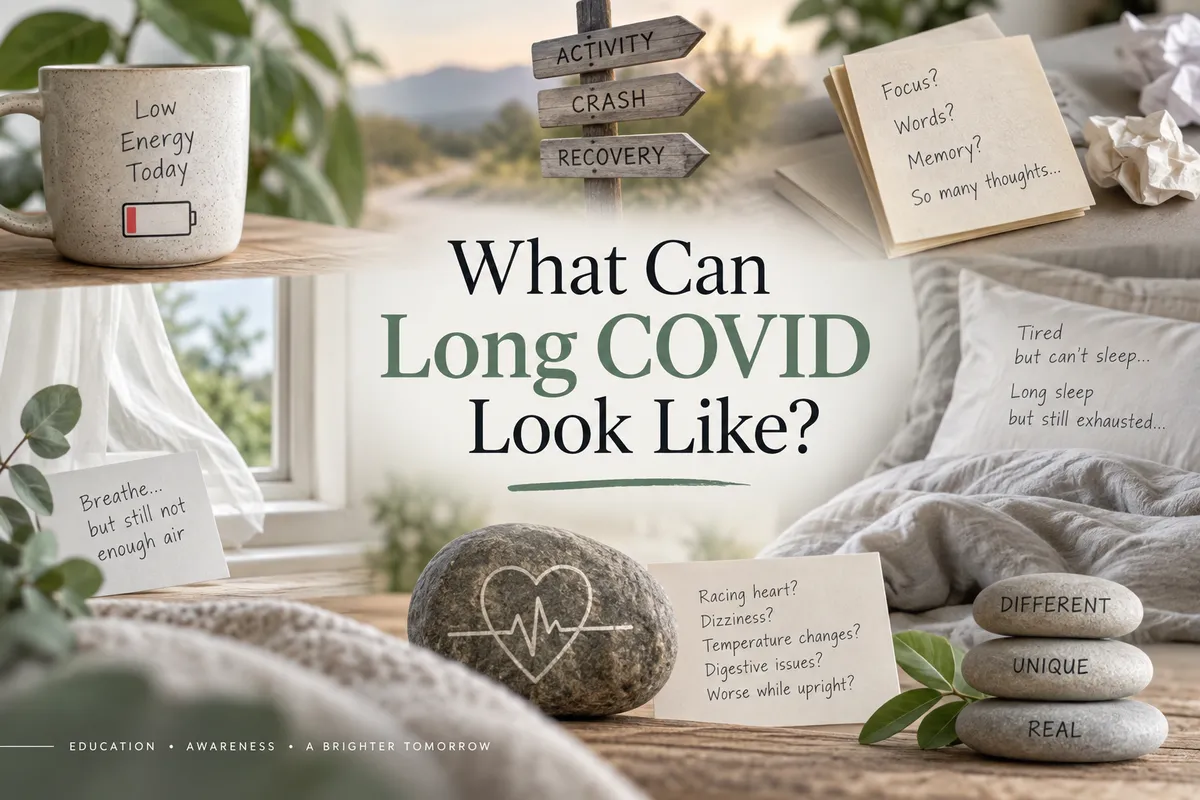
What can Long Covid look like?
Last week, we talked about what Long Covid is. This week, we’re talking about some of the symptoms people experience.
Before we get started, I want to make something very clear. This site does NOT provide medical or diagnostic advice. This article is for education and awareness. If you’re experiencing symptoms that could be related to Long Covid, a qualified medical provider can help you determine what may be causing them and discuss treatment approaches based on your unique situation.
I’m not going to try to give you a complete list of Long Covid symptoms. That would be a very long and boring read. There also isn’t one standard Long Covid experience. No two people have exactly the same experience, and Long Covid can affect virtually every organ system in the body. That leaves us with a lot of possibilities.
Today, I’m going to focus on six symptoms and symptom patterns I see people asking about most often. Don’t look for prevalence statistics here because there won’t be any. This list is based on my own observations of the questions and conversations I see again and again.
If you have all of these symptoms, that doesn’t mean you have Long Covid. If you have none of them, that doesn’t mean you don’t have Long Covid. Like I said, everyone’s experience is unique.
Why Long Covid can be difficult to recognize
There isn’t one standard Long Covid experience, so there isn’t one required set of symptoms that everyone with Long Covid will have. That alone can make it challenging to recognize.
Symptoms can also vary in intensity, disappear and return, and new ones can appear at seemingly random intervals. To make things even more interesting, not all of the symptoms appear connected. Issues that seem to have nothing to do with each other may actually be part of the same bigger picture.
This is where you have to become curious about your own patterns and start becoming your own Personal Health Detective.
Fatigue and energy limitation
Let’s kick this off with one of the first symptoms many people I’ve heard from notice: fatigue.
This is also one that can be difficult to truly understand until you experience it.
The National Cancer Institute (NCI) defines fatigue as “a condition marked by extreme tiredness and inability to function due to lack of energy.”
So, you aren’t just tired. Your ability to function can be affected because your available energy is drastically reduced. And that lack of energy can affect you both physically and mentally.
Post-exertional malaise (PEM) and PESE
You may also see the term PESE, or post-exertional symptom exacerbation. PEM and PESE are often used to describe the same general phenomenon: symptoms becoming worse after exertion. PESE is increasingly used because the term more clearly describes what is actually happening. I generally use PEM because that is how the concept was first introduced to me.
PEM isn’t just fatigue.
According to the Centers for Disease Control (CDC), PEM is a worsening of symptoms following activity. The activity can be physical, mental, or social.
There are a few things to keep in mind when talking about PEM. The response isn’t always immediate. The CDC notes that symptoms can worsen 12 to 48 hours after an activity, which can make it difficult to connect the crash to what triggered it. Symptoms can last for days or even weeks.
You may also notice that the amount of exertion that triggers PEM can seem fairly small compared with the crash that follows.
So, what does it actually feel like?
Personally, when I experience PEM, or a crash, it feels as if I’ve hit a brick wall while going 90 mph (145 km/h) without the protection of a helmet or even a car.
That’s very different from simply feeling tired after a busy day.
Brain fog and cognitive difficulties
Brain fog is another symptom I see discussed a lot. And, like fatigue, it can be difficult for other people to understand.
Something I hear when trying to explain it is, “Well, everyone gets forgetful from time to time.”
But it isn’t just being forgetful. Normal thought can be just plain hard.
It can be harder to focus, find words, process information, follow a conversation, remember things, or manage more than one piece of information at a time. Brain fog can interfere with both work and personal life.
The underlying causes are different, but the experience can be similar to what you may have heard described as pregnancy brain or chemo brain.
Sleep disturbance
Sleep disturbance doesn’t just mean difficulty falling asleep or waking frequently during the night.
Many people mention significant changes in their normal sleep patterns. There’s the “wired but tired” feeling where you’re exhausted but can’t fall asleep. Another issue that tends to surprise people is sleeping for long periods and still waking up exhausted or unrefreshed. This is known as hypersomnia, or excessive sleepiness and sleeping for unusually long periods.
Respiratory symptoms
COVID can affect the respiratory system, and some people continue to experience respiratory symptoms after the initial infection. If you already have a respiratory condition, such as asthma, you may also notice changes in your existing symptoms.
Some of the problems I see mentioned include shortness of breath, persistent cough, becoming winded easily, and air hunger, the feeling that you can’t get enough air into your lungs even though you’re breathing.
A note about breathing symptoms
New, significant, or worsening breathing problems should be medically evaluated rather than automatically assumed to be Long Covid. Not every breathing problem has the same cause, and this is definitely an area that needs to be evaluated by a medical provider.
Autonomic nervous system symptoms
This is one that can be challenging to wrap your head around.
Common autonomic symptoms can include:
Racing heart or palpitations
Dizziness or lightheadedness
Difficulty remaining upright
Temperature regulation problems
Digestive changes
Feeling worse while upright and better sitting or lying down
These can be related to the autonomic nervous system (ANS). The ANS helps regulate many of the functions your body normally handles without conscious thought, including heart rate, blood pressure, digestion and temperature regulation.
When that regulation isn’t working properly, symptoms can show up in seemingly unrelated parts of the body. That means something like a racing heart can sometimes be related to autonomic regulation rather than a problem originating in the heart itself.
If you’ve heard the term dysautonomia or the acronym POTS, this is where they come into the picture. Dysautonomia is an umbrella term for disorders involving dysfunction of the autonomic nervous system. POTS, or postural orthostatic tachycardia syndrome, is one type of dysautonomia.
A note about autonomic symptoms
New, significant, or worsening symptoms such as a racing heart, palpitations, dizziness, or fainting should be medically evaluated rather than automatically assumed to be caused by Long Covid or dysautonomia. These symptoms can have many different causes, so this is another area where evaluation by a qualified medical provider is important.
Long Covid symptoms don't exist in separate boxes
Long Covid symptoms aren’t necessarily separate or distinct. They can change, go away and come back. And your experience won’t necessarily match someone else’s.
Instead of expecting your symptoms to be the same every day, start looking for patterns.
I talked more about this in Why Do My Long Covid Symptoms Keep Changing? If your symptoms seem random or unpredictable, that article can help you understand why and give you another place to start becoming your own Personal Health Detective.
What if my biggest symptom isn't on this list?
Before I close this out, I want you to remember that these are simply six of the symptoms and symptom patterns I see discussed most often.
Long Covid is a multi-system condition with a very broad range of reported symptoms. Your biggest problem may be something I haven’t mentioned here at all.
Having all six of these symptoms doesn’t mean you have Long Covid, and having none of them doesn’t mean you don’t have Long Covid.
Start with what you're noticing
Ready to start becoming your own Personal Health Detective?
Start with three questions:
What is happening in my body?
When does it happen?
What seems to make it better or worse?
Get curious about your health and start making notes about what you notice. You don’t have to figure everything out at once.
Recognizing your own patterns is a good first step toward understanding your unique experience.
References
National Cancer Institute, definition of fatigue:
https://www.cancer.gov/publications/dictionaries/cancer-terms/def/fatigue
CDC, ME/CFS clinical overview including PEM:
https://www.cdc.gov/me-cfs/hcp/clinical-overview/index.html