
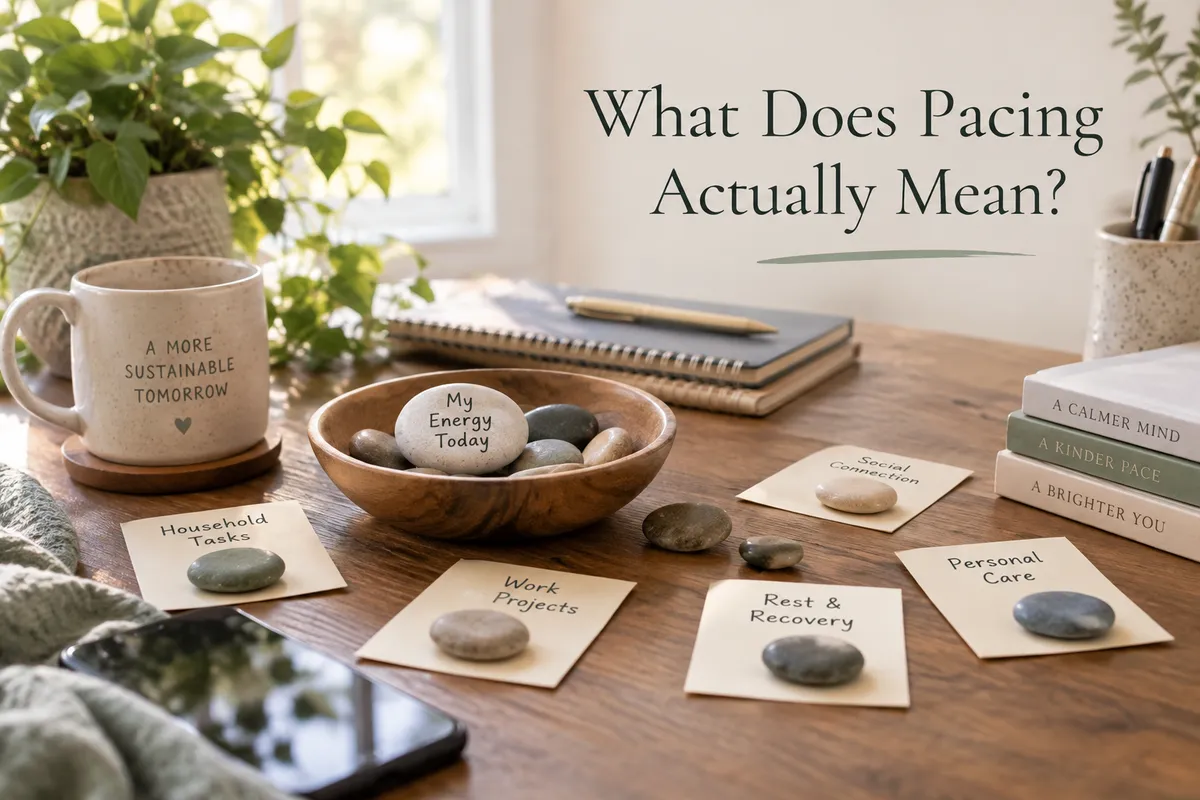
What Does Pacing Actually Mean?
“Pace yourself.” But what does that actually mean?
Something people with Long COVID hear a lot is, “Pace yourself.” And it truly is good, solid advice. When you’re dealing with chronic fatigue, post-exertional malaise, or dysautonomia, pacing is a vital skill.
But what, exactly, is pacing?
According to the Cambridge Dictionary, to pace yourself is “to be careful not to do something too quickly, so that you do not get too tired to finish it.”
Which is great, right? Kind of.
The problem with that definition is that it implies you just need to slow down and you’ll be fine.
It doesn’t answer questions like:
How do I know how much is too much?
How do I know when to stop if I feel okay while I'm doing something?
What about the things I have to do?
What if what I can handle changes from day to day?
It also leaves out some of the most important aspects of pacing yourself with an energy-limiting condition.
Pacing is a skill, not an instruction
I’d like to propose a different definition of pacing yourself.
Pacing is learning to recognize your current capacity and intentionally manage how you use your available energy so you're less likely to repeatedly exceed that capacity.
There are three important concepts in that definition.
Current capacity: You can’t pace yourself according to what you were able to do before COVID entered your life. You also need to take into account the fact that your capacity is going to fluctuate. If your capacity is the same every single day, you’re a rarity in this world (and I’m jealous!).
Intentionally manage your energy usage: You don’t pace yourself simply by doing less. You pace yourself by balancing what you need and want to do with how much energy you currently have available.
Less likely to repeatedly exceed: The goal isn’t to never exceed your capacity. Hopefully you’ve realized this already, but trying to be perfect is only going to increase your anxiety levels. The goal is to reduce how often you exceed it.
A couple of notes about measuring capacity.
If you’ve heard of Spoon Theory and wondered what that has to do with Long COVID, I had to look it up myself. It actually predates COVID. The following explanation is paraphrased from the Cleveland Clinic. Spoon Theory began as a metaphor created by someone with lupus to describe living with limited energy.
Spoon Theory is a way of visualizing limited energy. You start with a certain number of imaginary “spoons,” and everything you do costs some of them. A small task might cost one spoon, while something more demanding might cost several. Once you've used your available spoons, you don't simply get more because there's still more to do.
It isn’t something I personally use very often. I generally use PacePoints to describe my energy to others.
PacePoints come from the Visible app. Visible uses PacePoints to put a number on exertion. They accumulate throughout the day based on how much time you spend in different heart-rate zones. The app gives you a personalized daily PacePoints budget to help you visualize and manage your energy use. I have the wearable that works with Visible, so that’s the terminology I tend to use.
Both of these can be useful ways of thinking about energy, but there’s something important to remember: the numbers are tools, not guarantees.
It’s easy to look at those numbers and assume you’re going to have the same amount of energy available every day. But your actual capacity can change from day to day and week to week. The energy cost of an activity can change with it.
Emptying the dishwasher might feel like a one-spoon or one-point activity on Monday and a five-spoon or five-point activity on Thursday.
Think of the numbers as a convenient way to visualize your general capacity, not a precise measurement of what your body has available at any given moment.
Everything takes energy
When I started therapy and was introduced to the concept of pacing, I really only thought about physical activity. My therapist made it clear that everything requires energy, not just physical stuff.
You also need to consider cognitive, emotional, and sensory energy demands.
You use physical energy for things like walking, showering, cooking, doing housework, and standing.
You use cognitive energy for concentrating, reading, completing paperwork, making decisions, and having long conversations.
Emotional energy can be used by worry, conflict, grief, excitement, and stressful situations.
Sensory demands can include noise, bright lights, crowds, traffic, heat, and busy environments.
Which means that just because you’re reclining on the couch and not doing anything physical, you aren’t necessarily resting. If you’re scrolling, answering messages, making decisions, or worrying about tomorrow, you’re still using energy.
Pacing starts with paying attention
By now, you might be thinking, “Okay, this is all great and it’s starting to make sense, but what am I supposed to do with all of this? I still don’t know how to pace myself!”
The first step is to pay attention to your body and how it responds to activity.
It’s time to become a Personal Health Detective and develop some energy awareness.
Grab a notebook, or use the notes app on your phone or tablet, and start making some observations about how your energy levels change. Here are a few questions you might ask yourself:
What tends to take more energy than I expected?
What are the early signs that I may be reaching my limit?
What happens later that day or the next day?
PLEASE don’t try to take notes on everything. You’ll just get overwhelmed and probably won’t keep it up.
Start with a few notes here and there throughout the day, or take a few minutes at the end of the day to jot down your observations.
So what does pacing actually look like?
Pacing doesn't mean doing as little as possible. You're not trying to conserve every possible bit of energy. You're trying to make more intentional decisions about when, where, and how you spend the capacity you have.
That might mean breaking something into smaller pieces, changing how you do it, resting strategically, prioritizing, asking for help, or deciding something isn't worth today's energy cost.
Here are a few examples of what pacing might look like in everyday life:
You don't have to clean the entire kitchen just because you started cleaning it. Do part of it, rest, and decide later whether you have the capacity for more.
If standing to prepare dinner takes a lot of energy, sit for part of the task.
If you have a doctor's appointment in the afternoon, deliberately leave more space in your morning so you have energy available for it rather than trying to squeeze in several errands first.
If you've spent two hours doing mentally demanding work, take a break and truly rest instead of heading into the living room to clean because, after all, you were “just sitting there.”
Pacing is not just about doing less. It's about learning to make choices based on the energy you actually have available.
You won't get pacing right all the time
There’s nothing wrong with trying to get pacing exactly right. The problem comes when you expect that you actually will.
Perfection isn’t a realistic goal.
You’re going to misjudge your energy sometimes. You’re going to miss signals your body is giving you. You’re going to have days when something takes far more out of you than you expected. And sometimes life simply won’t give you the option to pace the way you would like.
Aim to get better at pacing, not to become perfect at it. Learn from the times you get it wrong and give yourself some grace along the way.
A crash doesn’t mean you’ve failed.
Instead of asking yourself what you did wrong, ask what you can learn from what happened, after you’ve had a chance to recover a bit.
Was there more activity involved than you realized? Did several things add up? Were there cognitive, emotional, or sensory demands you hadn't considered? Maybe when you look back, you realize there was an early warning sign that wasn’t obvious at the time.
It’s all information.
And that’s really what learning to pace is about. You’re learning your body, your patterns, your limits, and the signals that tell you when your capacity is changing. You won’t figure all of that out in a day, and you don’t need to.
Start by paying attention. Then use what you learn to make the next decision a little more intentionally.
If you’d like some help putting this into practice, we’ve been talking about pacing in detail inside the Your Long COVID Transformation community over the past few weeks, and we still have several weeks of pacing topics ahead of us. We’re taking these concepts one piece at a time and looking at how to use them in real life.
Because “pace yourself” is good advice.
But learning how to pace yourself is where it actually becomes useful.